Skill Swap or Shared Workshop? Choosing a Format That Fits
Skill swap or shared workshop? Compare teaching needs, shared materials, and available help to choose a format that gives learners useful practice.
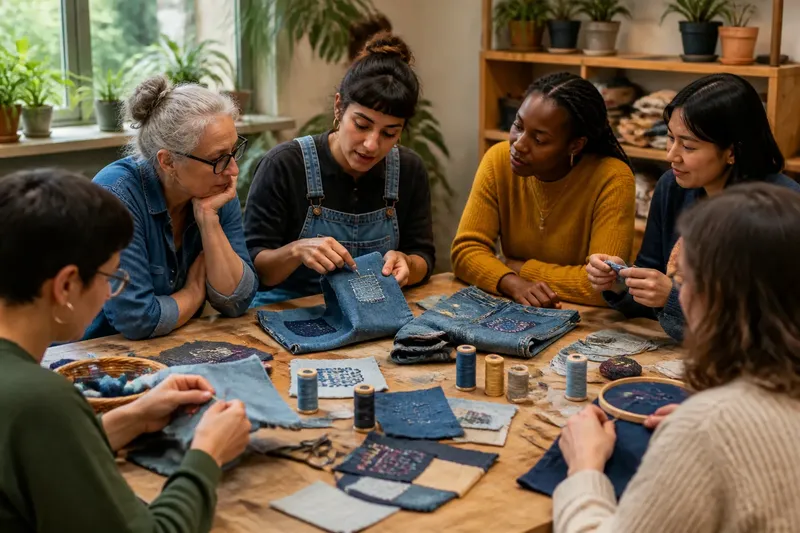
For a skill swap or shared workshop, start with the kind of help the activity requires: a torn seam may need individual attention, while a shared stitching method can be taught to a group. That distinction helps a neighborhood group choose a format before arranging tables or inviting participants.
Imagine a neighborhood group planning a visible-mending session. Mina can show how to patch denim, and several neighbors want to learn, but they bring different fabrics and projects. The group needs to decide whether to pair people up or gather around one demonstration.
What does the skill require?
Separate the parts everyone can learn together from the parts that depend on an individual project. In visible mending, choosing a patch and securing its edges may be common lessons; a tear beside a seam or a stretchy fabric can call for more tailored guidance.
A shared sequence with similar materials often suits a workshop. Learners can watch one demonstration and practice the same technique. If each person’s task calls for different tools, adjustments, or close correction, a pair or a few small groups may be easier to support.
These are useful tendencies, not fixed rules. A workshop can accommodate different projects if the facilitator can circulate, and a pair can practice a shared technique if both people prefer a quieter pace.
How does a skill swap work?
A skill swap is an exchange in which people offer something they know and learn something they want to try. The exchange can happen in one meeting or over several; the two people do not have to teach at the same time.
Before meeting, agree on the task each person wants to teach or learn. “I can show you a running stitch, and I’d like help setting up a herb planter” gives both people a clear starting point. If one person is not ready to teach, describe the meeting as peer practice or an informal skill share rather than treating help as a debt.
The format offers room to pause, repeat a demonstration, and adapt to one person’s materials. Its trade-off is limited reach: if several neighbors want the same explanation, separate exchanges may repeat the same lesson. A swap fits best when the participants have compatible goals and value focused, mutual attention.
What does a workshop make easier?
A workshop brings learners together around a common activity, usually with a facilitator or a small team of helpers. Mina could demonstrate a patch on denim, explain how to secure its edges, and invite everyone to practice on fabric scraps before working on clothing.
One demonstration can serve several learners, and a question from one person may clarify a technique for the whole table. To keep the session usable, Mina can teach one part at a time, pause for practice, and leave room for individual questions.
The main trade-off is shared attention. If some learners need frequent, hands-on correction, the facilitator may not be able to support everyone at once. A smaller group, an additional helper, or a paired practice period can make the activity more manageable.
How should you plan the format and supplies?
Match the invitation and materials to the task rather than choosing a headcount first. For a visible-mending workshop, Mina could ask participants to bring a garment and, if they have them, a needle and thread. She can provide fabric scraps for practice and a few shared tools, then explain which project details may need separate attention.
- Check whether participants want the same technique; if they do, plan one shared demonstration, but if their goals differ, arrange pairs or separate activities.
- Check whether the projects use similar materials; if they do, prepare a common practice material, but if not, ask participants to bring suitable scraps or plan individual guidance.
- Check whether the facilitator can see each person’s hands; if visibility is good, use a shared table, but if not, rearrange seats or demonstrate in smaller circles.
- Check whether the activity needs frequent correction; if it does, invite fewer learners or add a helper, but if it does not, a larger workshop may be workable.
- Check whether participants have the basic tools; if they do, ask them to bring those tools, but if not, arrange shared supplies or choose a practice task that uses what is available.
- Check whether a project requires specialized expertise; if it does, keep that work outside informal instruction and direct the participant to an appropriate qualified person, but if it does not, continue with the planned peer lesson.
It is not worth building an elaborate matching system before a first session. A clear invitation asking what people can share, what they want to learn, and whether they prefer a pair or group can reveal the main planning needs.
Which format fits Mina’s session?
Say several neighbors want to learn the same basic patch, and Mina can see everyone’s practice work from the table. She brings fabric scraps, needles, and thread; demonstrates the stitch; and gives each person time to try it. If a participant’s garment has a difficult seam, Mina can set that repair aside for individual help rather than holding up the shared lesson.
Now imagine only one neighbor can attend. The neighbor wants to learn how to repair a tear along a jacket seam, while Mina wants to learn a simple decorative stitch. They agree to demonstrate those tasks on fabric scraps first, then decide whether the techniques suit their garments. The expected observable result is that each person can practice the agreed skill and identify any project detail that needs further help; they do not assume the swap will resolve every repair.
If Mina instead wants to learn bicycle brake-cable adjustment, she should not treat that as an ordinary casual swap. Brake work affects safe operation, so the neighbor should refer her to the bicycle manufacturer’s instructions or a qualified bike mechanic rather than attempting to teach a repair beyond their expertise.
What questions help you choose a format?
When is a skill swap a good fit?
Choose a skill swap when two people have clear, compatible goals and each can offer the kind of help the other wants. It is especially useful when a learner’s materials or questions call for individual attention.
When does a workshop fit better?
A workshop fits when several people want to learn a shared method and can benefit from the same demonstration. Keep the group small enough for the facilitator to see practice and respond to questions.
Can a session combine a demonstration and paired practice?
Yes. A facilitator can teach the shared method to everyone, then arrange pairs to practice and compare their work. Make clear that peer practice is not a substitute for qualified help with specialized or safety-sensitive tasks.
What if participants have different experience levels?
Ask what each person has tried and what they want to be able to do. If they can work from a common starting point, offer a basic demonstration with optional variations; if their needs are too different, use separate pairs or plan another session.
How can you make the next session more useful?
After the activity, note which parts participants could practice independently and which required extra explanation. That observation can guide the next decision: repeat the same workshop if the shared lesson worked, add a helper if questions stacked up, or offer paired practice if individual projects needed more time.
For a skill swap or shared workshop, the practical choice is the one that fits the task and the available teaching attention. A short note about what people practiced and what remains unclear gives the group a concrete basis for planning its next meeting.